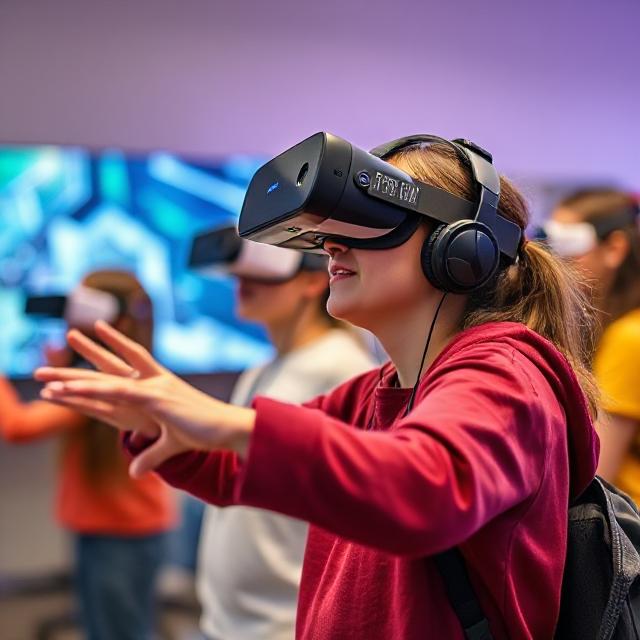
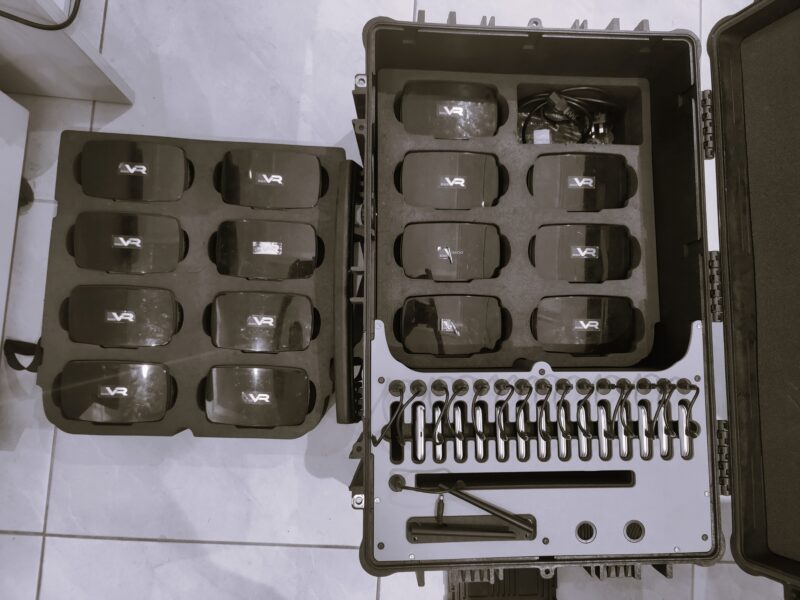
The Malta School of Art has recently been equipped with 16 Virtual Reality (VR) headsets, generously provided by the Directorate for Digital Literacy & Transversal Skills (DDLTS) as part of the school’s consolidation of digital competencies. The goal is to explore the potential of VR technology to enhance teaching and learning in art education. The School will incorporate skills acquired from the recent Erasmus Plus – DigitalTech Methods Project funded by the EU – integrating VR into various aspects of the curriculum, including digital art, art history, and innovative digital art workshops, thereby enriching the educational experience for students and educators alike. This important investment is in line with the ambitions and targets of the Malta New Education Strategy 2024-30, which placed significant emphasis on the integration of digital tools to enhance the educational experience. After this induction process the school will invest in a new VR equipment which will be an integral part of the school of art digital resources.
The integration of Virtual Reality into the classroom offers a wealth of pedagogical benefits, providing a rich, immersive learning environment that traditional methods cannot match. VR allows students to explore complex subjects interactively and tactilely, catering to diverse learning styles and preferences. It enables students to experience historical events, explore distant environments, and gain new perspectives without leaving the classroom, fostering empathy and a deeper understanding of the topics studied. When implemented effectively, VR can transform lessons into engaging, memorable experiences that stimulate curiosity and active participation.
Beyond enhancing engagement, VR technology supports a variety of educational goals, including increasing knowledge, fostering creativity, and inspiring career aspirations in science and the arts. It simplifies complex concepts, making them more accessible and easier to comprehend. VR also encourages experiential learning by providing realistic scenarios that are otherwise difficult or impossible to replicate, thus broadening students’ understanding and empathy. As an innovative and enjoyable tool, VR is poised to push the boundaries of art education at the Malta School of Art, offering students a dynamic platform to explore, create, and learn in new and exciting ways.

The Mikiel Anton Vassalli College is the national network of specialised schools for Visual and Performing Arts Education in Malta and Gozo.
Malta Office of the College Principal
32, Joseph Abela Scholaro Street,
Hamrun HMR 1304, Malta
Gozo Office of the College Principal,
Mikiel Anton Vassalli College, Industrial Zone,
Jean De La Valette Street,
Xewkija, XWK 3000, Gozo
+356 2598 3710
mavassalli.college@ilearn.edu.mt